
"I felt as if my inner world at 80 found a mirror that reflects us all …
– a mirror that was your film – connecting us all."
–Lucy, San Francisco
Friday evening, Ruth’s Table hosts a screening in their lively Mission District arts center – the seats fill with members and guests from across San Francisco, ages 17 to 90.
Sunday afternoon at the Unitarian Universalist Church on Franklin Street, congregants share a sandwich and coffee before the film starts – a warm, connected, church community.
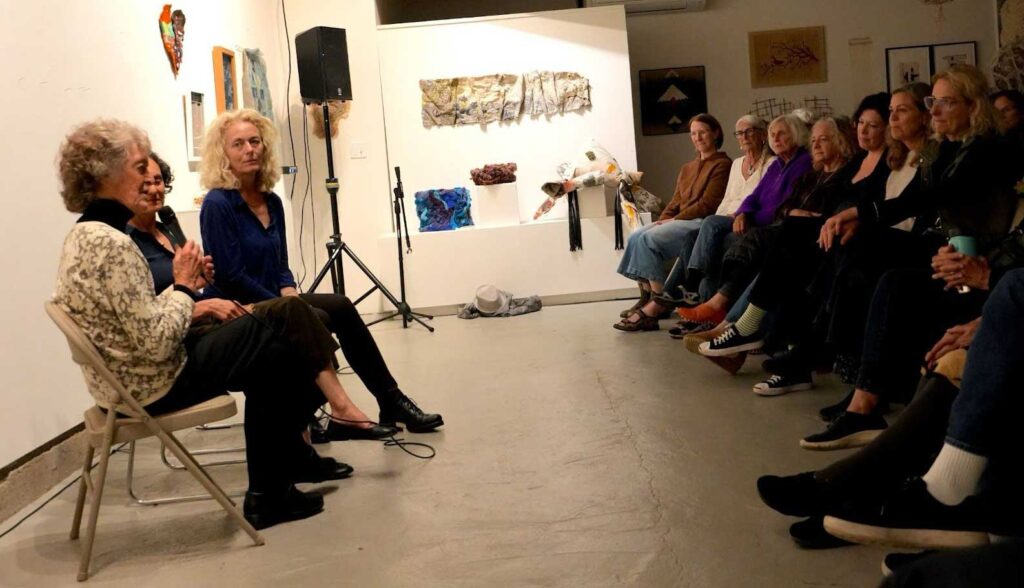
Night falls in the redwood groves around the O’Hanlon Center for the Arts as Marin residents and local artists take their seats among the woven art pieces currently on display. (photo)
What do these events have in common? What makes a community screening?
We are emotional, social beings. Watching together in a group changes how we see. We aren’t consuming this film on our personal device. We have taken the opportunity – and for some, the risk – of entering into community for this experience.
I love this opportunity to share the film in real time with a real group of people. It’s a chance to gather glimpses of how people have been touched and what resonates for them in their own lives. A teenager explains that she – like Margot and Barbara – feels the loss of people in her life because she is heading off to college. It wouldn’t have occurred to me that this could be a point of commonality between a 17- and an 85-year old. A man remarks how the super 8 sounds took him back to his childhood, watching films on a projector. I, too, love the physicality of film running clack clack through the gate.
The emotional aspects of the film carry us towards a rich, personal conversation in the audience discussion afterwards.
A woman thanks us for the quiet spaciousness in the film. Someone tells us he is about to turn 80, and how the stones slowly falling into dust gave him a tactile, sensual image for the new phase of his own life.
People later will comment how surprised they themselves are by what they – or their partner or their child – shared with the room. Tears and laughter, questions about Margot and Barbara and stories from the audience’s own lives bring us together.
Through our shared reflections, we connect.