
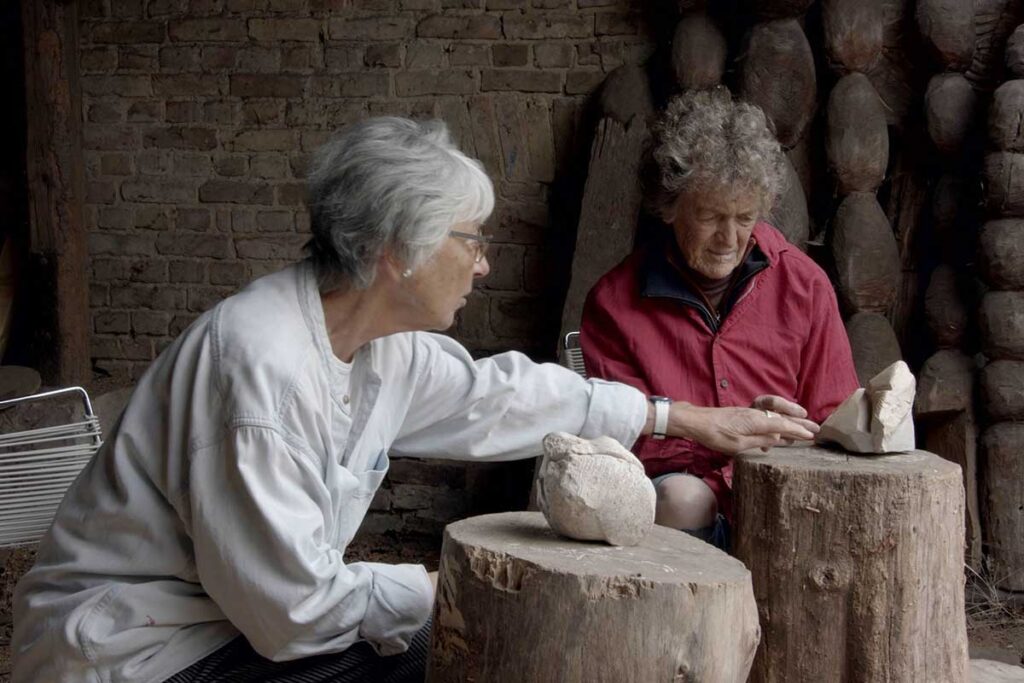
In their 90s, Sarah Gross’ mom, Margot, and mother-in-law, Barbara, have a growing fan club. Gross isn’t surprised. After screenings of her new documentary, “Grains of Sand,” which features the two women, she hears time and time again how people want to be like them when they’re older.
The film, which was shot over eight years in the Bay Area, United Kingdom and Germany, showcases the women’s deep, nurturing friendship; their lifelong artistic practices; their connection over art, traveling and learning about other cultures; and how they navigate and think about aging as they enter their 80s.
And, for a few years, they gathered each year for an artistic retreat at a stone farmhouse in Germany, not too far from where Gross and Barbara live, to connect and create art.
A preview screening of the film will take place at 7 p.m. Oct. 17 at the O’Hanlon Center for the Arts in Mill Valley, where Gross’ mother, a painter based in San Francisco, has exhibited. A donation of $10 to $20 at the door is suggested.
Gross and Suzanne Reich, a museum docent and fellow Harvard grad, will present a collage workshop tied to the film at 10 a.m. Oct. 18 at the Mill Valley arts center. Admission is $25. RSVP to both events at ohanloncenter.org.
At its core, the film is a coming-of-age story — at 80 years old, Gross said.
“’Grains of Sand’ offers a counternarrative to the marginalization and invisibility of older people in our society, particularly women, by affirming the importance and relevance of their work and life experiences.
The film unpacks formative moments in their biographies, reflects on how they grappled with traditional societal expectations of women and creates space for issues of aging usually ignored by society — such as fear of death, illness and body pain,” said Gross in her director’s statement. “It’s a testament to the power of art and friendship and a personal exploration of what it means to age and continue becoming oneself.”
The film made its debut earlier this year at Greece’s Thessaloniki International Documentary Festival.
In their 90s, Sarah Gross’ mom, Margot, and mother-in-law, Barbara, have a growing fan club. Gross isn’t surprised. After screenings of her new documentary, “Grains of Sand,” which features the two women, she hears time and time again how people want to be like them when they’re older.
The film, which was shot over eight years in the Bay Area, United Kingdom and Germany, showcases the women’s deep, nurturing friendship; their lifelong artistic practices; their connection over art, traveling and learning about other cultures; and how they navigate and think about aging as they enter their 80s.
And, for a few years, they gathered each year for an artistic retreat at a stone farmhouse in Germany, not too far from where Gross and Barbara live, to connect and create art.
A preview screening of the film will take place at 7 p.m. Oct. 17 at the O’Hanlon Center for the Arts in Mill Valley, where Gross’ mother, a painter based in San Francisco, has exhibited. A donation of $10 to $20 at the door is suggested.
Gross and Suzanne Reich, a museum docent and fellow Harvard grad, will present a collage workshop tied to the film at 10 a.m. Oct. 18 at the Mill Valley arts center. Admission is $25. RSVP to both events at ohanloncenter.org.
At its core, the film is a coming-of-age story — at 80 years old, Gross said.
“’Grains of Sand’ offers a counternarrative to the marginalization and invisibility of older people in our society, particularly women, by affirming the importance and relevance of their work and life experiences.
The film unpacks formative moments in their biographies, reflects on how they grappled with traditional societal expectations of women and creates space for issues of aging usually ignored by society — such as fear of death, illness and body pain,” said Gross in her director’s statement. “It’s a testament to the power of art and friendship and a personal exploration of what it means to age and continue becoming oneself.”
The film made its debut earlier this year at Greece’s Thessaloniki International Documentary Festival.
Sharing stories
Gross is no stranger to picking up the camera and filming the stories and people who speak to her. Through her company, Bugle Films, whose mission is to “make the world more empathetic — one story at a time,” she’s shared the lives of Syrian refugee students in “Bourj Stories”; a South African woman striving to become a leader in her township community 25 years post-apartheid in “A Growing Thing”; and her own family’s story in “Brown Bread.”
Gross’ American dad and British mom raised six kids of different ethnic backgrounds in the Bay Area, four of them whom they adopted.
When Gross decided to film these “strong, supportive women” in her life, she initially wanted to capture this new phase of their lives as they entered their 80s and what that might mean or look like. As she began to film, it started to take shape in a different way than she imagined.
“When my mom was going to turn 80, I thought, this is it. This is the end of her life. She’s looking back on her life. I have to go through this with her now. The more we filmed, the more I was like, she’s not looking back on her life. She’s living it,” Gross said. “She’s got both feet in her life right now.”
It unraveled into a special time not only for quality time together but also for the chance to ask them questions she hadn’t before, such as about their wartime experiences. The two grew up in countries at war with one another; Margot grew up in England and German native Barbara grew up in what is now Poland.
“It was a really special time,” she said. “Conversations with the camera are more focused, more intense. You’re really being purposeful and talking in a purposeful way. You get to talk about things that you normally don’t really in daily life. Making the film was a wake-up call, and the film itself can be a positive wake-up call of, hey, we can ask those questions. We can connect. We can take that time. And that will enrich us all.”
And it felt like a “privilege” to be able to go into their art studios, their havens from the world where they can be fully themselves. Her mom has an almost ritualistic experience, coming in and putting on a special sweatshirt each time she steps foot inside it.
The film also captures how the friends try to stay connected through the early days of COVID while being continents apart. When they first are able to see each other on Zoom, they tear up and soon start to share their art — holding up pieces to the camera — and stories of their day. They still Zoom to this day.
“I think the friendship is so important because it shows them as peers,” she said. “They don’t see each other as old, you know.”
While Gross “never wanted the film to stop,” she knew when it had come to its natural end. She’s happy that they’re alive and able to enjoy it and engage with the film and discussions as she takes the film around the world.
And, of course, they’re both still doing art.